Solving my own Missing Building Mystery

Separate from my ongoing plaque hunts, since moving into the city from the suburbs, I have been looking for a particular funeral home because of its proximity to a nearby church. In retrospect, it was the event that really made me focus and wonder about my surroundings. In 1991 my grandfather died. I was 16 and this was my first introduction to death. My family lived on the outskirts of Ottawa before my city was incorporated as part of the megacity in 1999. I was overwhelmed by the capital, its many close streets and cars compared to where I grew up. A particular memory of that time I remember getting some air on the veranda of the funeral home with the sun setting in my eyes. But what really sealed the building in my memory was that we didn’t need a hearse to take my grandfather to the church, the pall-bearers carried him from there to the church across the street. I wondered if this was a standard thing (no it isn’t). There can’t be very many funeral homes where you can do that?

Retrospectively I was pretty sure this all happened in Centretown and I have been wandering around looking for this funeral home for my own genealogy purposes. I was sure that the building would be on the east side of the street to account for the setting sun in my eyes. Last Wednesday I realized I had walked all of the areas that I had thought it could be. This was a troubling thought, how could I have missed it when I am specifically looking for hidden and forgotten things? 

With my brand new newspapers.com subscription, I finally found his obituary which contained both the funeral home address, as well as the corresponding church. The church was the one I thought it was but I was somewhat confounded as to how I missed the funeral home as I had just been on that street. A repeating theme resonating with my obsession to document the location of plaques, you cannot find a building that isn’t there anymore. A google search on the address and I discover that it is now condo towers with a nice explanatory article by the ottawamagazine.com posted in 2011. 
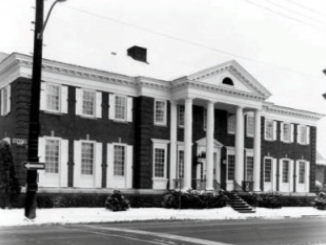
McEvoy Shields Funeral Home, 245 Kent Street. Photo credit Ottawamagazine.com

I am relieved that I have found it now. One more mystery put to bed. For my genealogy research, I now know exactly which church I will be directing my next course of correspondence. 

Reference:

https://ottawamagazine.com/homes/from-the-print-edition-from-georgian-style-funeral-parlour-to-art-deco-condo-towers/ Then and Now: From Georgian-style funeral parlour to art deco condo towers. Posted October 4, 2011, accessed November 18, 2020.
Walking between Bronson Ave. and Kent St.

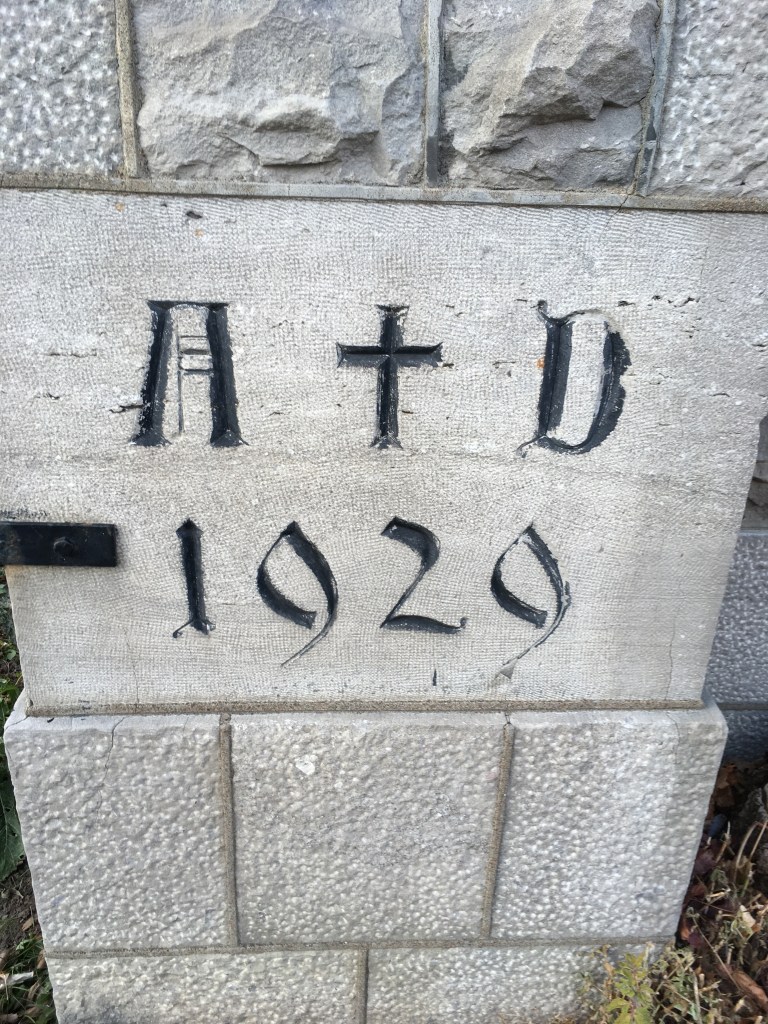
I took today off from work to go plaque-hunting. It was -7C in Ottawa this morning and about -3C when I started out. Plaques were not as bountiful as I had hoped, but when I did find them they were plenty. Bronson Centre, previously Immaculata High School, had four cornerstones, one plaque and an art piece. On the same building were two different cornerstones with differing dates. I bet there is a story there. And I am going to find out what it is.

I have to say this method of research is a healthy one. Today I did over 13000 steps. Most days during our pandemic reality I haven’t managed more than 2000 without extreme effort and/or planning. Clear and bright skies coupled with a rather walkable temperature made for an uncomplicated and enjoyable fall afternoon out.

Hollywood Parade

A friend of mine was viewing my new website and blog and mentioned that they had never heard of Hollywood Parade which was one of the photos I had taken and featured on the main page. I said that was exactly why I was determined to write about these lost bits of history. They are everywhere and often overlooked. 

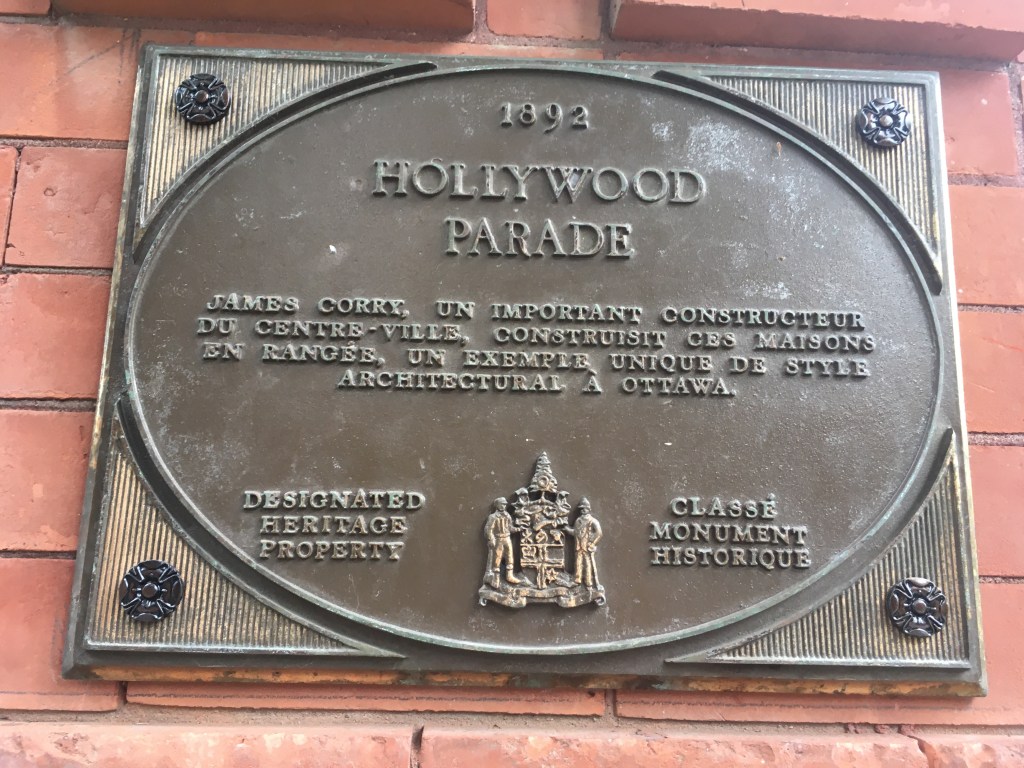
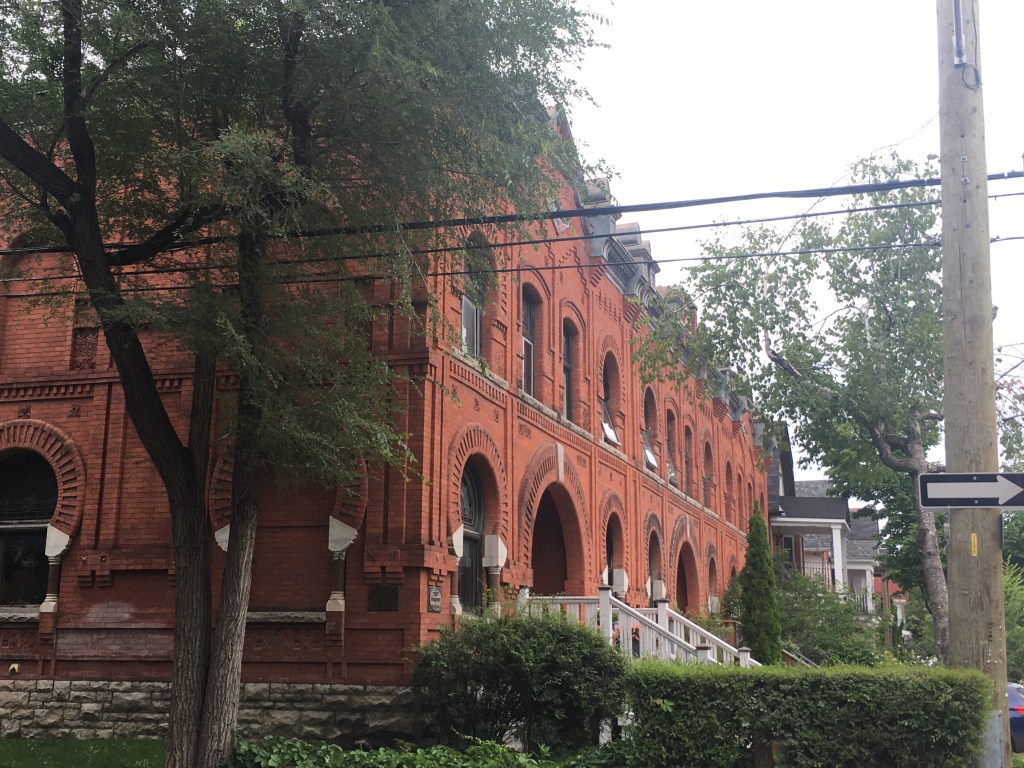
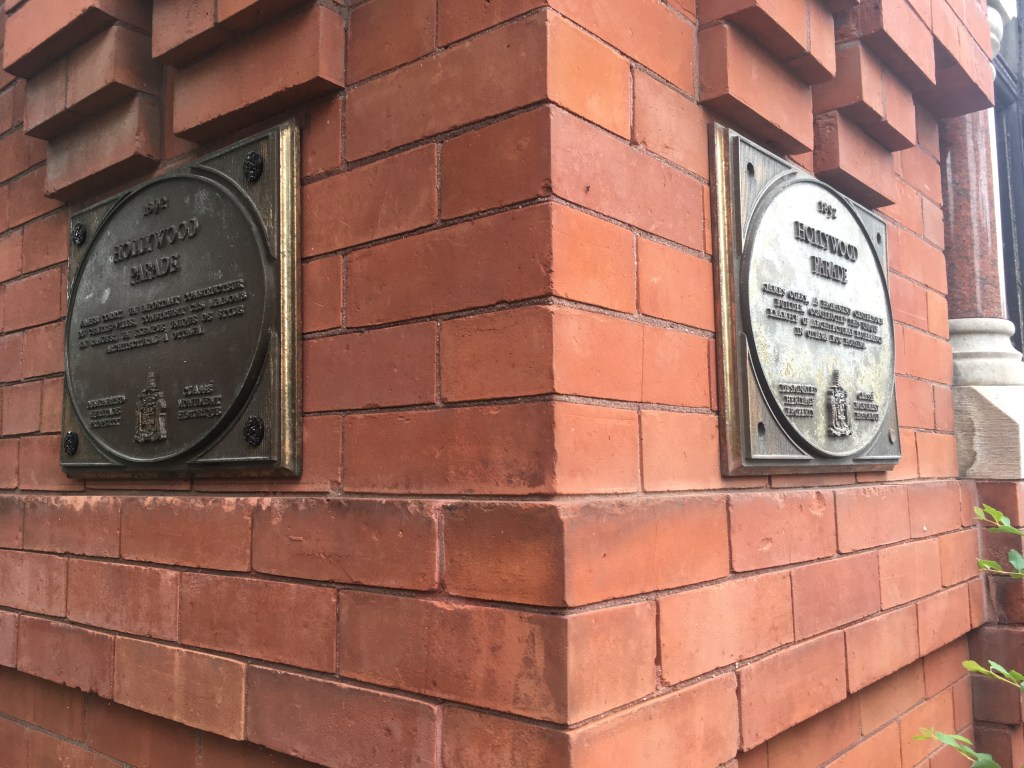
The plaque for “Hollywood Parade” and its 1892 cornerstone is at 113 James Street (and Lyon) in Ottawa. It is a Designated Heritage property. I will follow up with another post as to what that means and entails. But at the moment it means it is a nice old place in the center of Ottawa. 

I had seen this almost 130 year-old property earlier on walks. The red brick detail on the rowhouse is eyecatching. I am not well versed in architecture but it is described as the “Romanesque Revival” style.  It was featured in the 1998 Citizen Homes section and I feel that this sort of detail and craftsmanship isn’t incorporated into our modern homes. James A. Corry was the architect, builder and one of the original inhabitants of the six-unit row house. The rather grandiose name and its history remain a secret although it has been suggested that it was selected in order to give it higher aspirations than what was considered common row housing to the upper classes. Bytowne museum has suggested that it is meant as holly wood, to indicate nature, as present-day developments such as Deer Fields, try to imply.

In 1892 James Corry ran for the Wellington Ward alderman position, where he describes himself as being a resident of the ward for a number of years “with considerable interest therein.”  He is found arguing in the paper for wooden sidewalks (and denied) on neighbouring Florence street. There is an Ottawa Journal article in 1903 referring to ex-alderman James A. Corry, as the owner of land purchased on Rideau street to build office buildings, as well as other Ottawa projects. He died at the age of 65 on December 17, 1923.

Feels like the first day with a new pair of feet.

As I crash around this new webpage publishing medium I feel incredibly clumsy and deeply thankful that someone automated the hardwork. This is the space I’ll be posting about my plaque-hunting adventures with more indepth context on specific items of historical significance that will be under the soon-to-be created “Short History Sunday” series to be uploaded in the new year. (2021)

I have always been interested in the small histories, ones that as a single instance rarely fill a whole book but those which have had an impact on individuals and their community. I have stopped the car and dragged my hapless kidlets off to look at a plaque on many a car trip. And sometimes, over time, those plaques have disappeared. At first I thought I just mistook the location but have discovered that they sometimes disappear because their original meaning has been forgotten, the place destroyed or the plaque fallen down forgotten and lost. The neighborhood that inspired me to write this book was in Hintonburg. In 2010 I saw a plaque that had fallen down and was propped up in a window. After initial inquiries, I failed to continue to think about the lost little plaque further until the Magee house partially collapsed in 2018. As it turns out there isn’t a large database of the location of every plaque, as each may be given by a different organization or level of government, and ongoing maintenance isn’t followed up upon.

I would like this book to be a useful walking guide to historians now and in the future, and indication of where items of note were located and at that same time creating a time capule for what was commemorated indicates what was considered important to us as a community.

I hope you enjoy finding out our local secret places. This is my map of Ward 14 in Ottawa that encompasses Little Italy, Chinatown, Sparks street, and Parliament Hill: https://www.google.com/maps/d/u/1/edit?mid=1Yt6tJaDfBwwCG9kDueModU9w-08pfOrz&usp=sharing

I am adding as I collect them. At the moment I have collected more than I have sat down to do the data entry for, but that is what the cold winter months are for aren’t they?