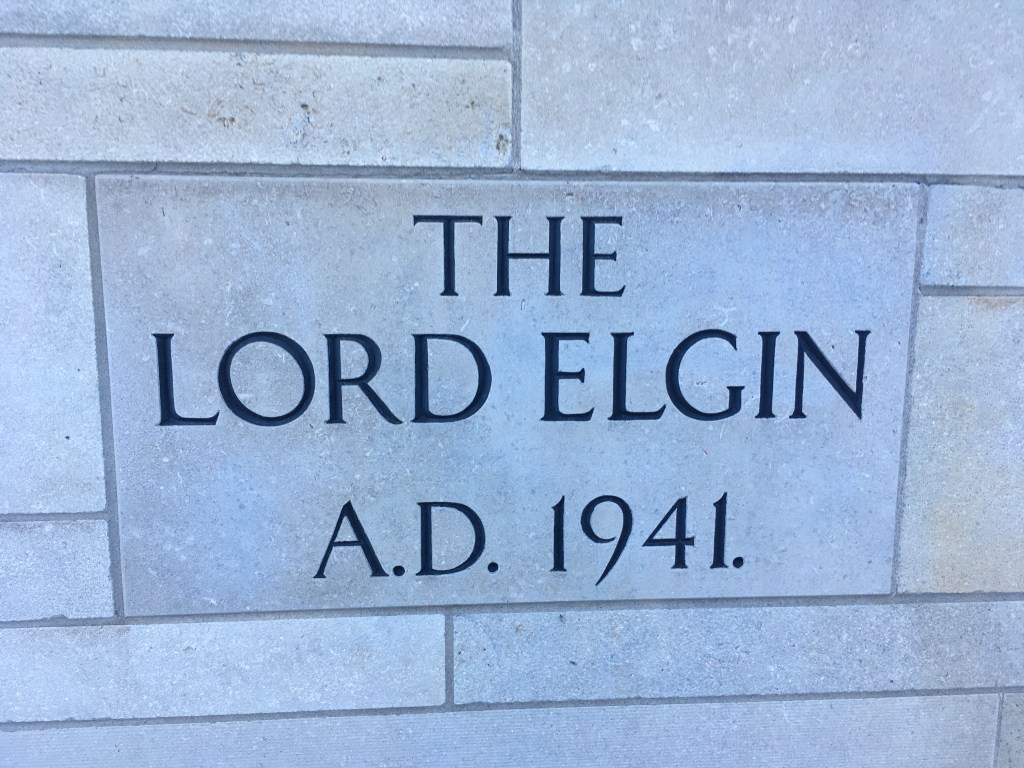
The definition of a datestone is an engraved stone set in a building. I suppose for argument’s sake a datestone and a cornerstone are the same thing when they are actually on the corner of a building. I am making the decision to call it a datestone to call attention to the fact that you won’t find it on the corner of the building when you are looking for it. The datestone is located on the front of the building at 100 Elgin Street, of the Lord Elgin Hotel.
The construction of the Lord Elgin Building was built by local and unionized men as a newly evolved City of Ottawa priority. (The Ottawa Citizen, November 1940) The City was also enthusiastically anticipating receiving taxes from the 99-year lease because business ventures remit taxes, and government properties do not. (The Ottawa Citizen, November 1940)
The datestone was laid during World War II on February 27th, 1941 by Prime Minister of Canada, William Lyon Mackenzie (WLM) King, with the Chairman of the Industrial Publicity Committee, Mr. Hamilton, and the President and Managing Director of Ford Hotels, Inc., Mr. Udd. WLM King’s speech touched on the Greber plan and setting an example as a city. (Library and Archives Canada, Page 1 & Page 2)
The original purpose of the Lord Elgin Hotel according to the survey done by the hotel sub-committee of the Civic Industrial and Publicity Committee, was to encourage tourists to come to Canada’s Capital. This survey was taken in New York, Washington, Philadelphia, and Baltimore and the results indicated that Americans were hesitant about planning to visit Ottawa due to having uncertainty about the availability of lodging. (The Ottawa Citizen, November 1940)
General interest surrounded the construction of the building over the year as detailed in newspaper articles. There were work delays such as a four-week delay in access to steel, slowed the construction, and threatened to change the opening date from June 1st, 1941. (The Ottawa Citizen, December 1940) Apparently, there was some debate in the general populace as to whether the “g” in Elgin was to be pronounced hard or soft. So much so that direction was received from Lord Elgin of Broomhall, Dunfermline, Scotland who stated that the family pronunciation used the hard “g”. (The Ottawa Citizen, January 1941) Rumours also had to be quashed regarding the federal government having plans to take over the new hotel for office accommodation. (The Ottawa Citizen, January 1941) Sadly a worker was killed on site, Charles Nelson Corbett of 36 Bolton Street, from a fall from the unfinished second floor. (The Ottawa Citizen, February 1941)
The Prime Minister’s diary entry for the day contained an outline of the speech he gave and some personal thoughts on the occasion, “As I dictate this line, there comes to my thought the significance of a cornerstone of the British Commonwealth of Nations being that of Responsible Government, …”, he muses as he goes on to say that he had not thought to add this to his speech earlier in the day and wishes he had. He links the newly laid cornerstone to the cornerstone of his great-grandfather’s home in Niagara being the birthplace of Responsible Government, and he believed his part in the laying of the Lord Elgin Hotel cornerstone was the “Hand of God, in the affairs of men”, drawing the line from Lord Elgin having recognized William Lyon Mackenzie’s Responsible Government work, now being recognized in the capital. (Library and Archives Canada, Page 1 & Page 2) The stone contains issues of the daily newspapers, coins, and a signed scroll by all those taking part which read “We who are living today have faith. There will always be an England. Democracy will always prevail.” (The Ottawa Citizen, February 1941)
 Plaques, Statues and Cornerstones