Eglise Unie Saint-Marc 142 Lewis St.

A 1874 datestone on a church that was built in 1900 is always a fun quirky thing to find. That place has to have a story.  One may assume, the datestone gives evidence that Saint Marc’s Church has been at this Elgin/Lewis street location since 1874. Saint Marc’s Church has been here in Ottawa, (The Daily Citizen, February 1886) but its physical location has moved during that time. The church was founded in Ottawa in by Rev. Marc Ami in 1872 and held services at the Young Men’s Christian Association and other halls until 1885 when they built their church (The Daily Citizen, February 1886) to serve the Francophone Presbyterian community at 656 Wellington in LeBreton Flats. 


The LeBreton Flats church was destroyed in the 1901 Ottawa/Hull fire (The Ottawa Citizen, October 1964) and was rebuilt in 1902. (The Ottawa Citizen, May 1954) The new church was could seat 250 people built in the Gothic Revival style of brick and stone with a cornerstone placed on June 21, 1901, which outlined in French the destruction and rebuilding of the church. (The Ottawa Journal, June 1901)

Image – Library and Archives Canada

https://recherche-collection-search.bac-lac.gc.ca/eng/home/record?app=fonandcol&IdNumber=3816030&new=-8585513821113538419

Insurance plan of the city of Ottawa, Ontario, Volume 1, September 1902, revised 1912, Listed on 54 of 97, sheet 49. {address 656 Wellington, Lebreton Flats}, Anglicized? French Presbyterian Church, St. Mark (St. Marc)

Rebuilding after the fire Saint Marc’s served the Francophone community in LeBreton flats for 63 more years until the land the church owned was expropriated in 1964 (The Ottawa Citizen, October 1964). Front page news of the Government expropriation of the LeBreton Flats was announced in April 1962 giving owners only 2 years notice to vacate (the Ottawa Citizen, April 1962). While it was never realized, the intention of the expropriation was to build 10 government buildings in the area, with underground parking, and recreational and park areas to beautify the area (the Ottawa Citizen, April 1962). 240 owners were affected as the government removed the “eyesore” of “industrial plants, commercial buildings and low standard housing” (the Ottawa Citizen, April 1962). The land was not developed, and in 1969 the National Capital Commission was considering a reassessment of the LeBreton lands (The Ottawa Citizen, November 1969). Now 60 years later it consists of the War Museum, an apartment complex, (The Ottawa Citizen, April 2022) and the new Ottawa Public Library and, Library and Archives complex, Adisoke.

Saint Marc’s last service at the LeBreton Flats location was held on October 4, 1964 and the congregation was made up of 100 French-speaking families from all over the Ottawa area (The Ottawa Citizen, October 1964). The organ, pulpit, communion table, and other furnishings were to be removed before demolition to be placed in the new church when it was built (The Ottawa Citizen, October 1964). Their temporary church location from October (1964 until June 1965) was at Bank and McLeod  in the basement of the former McLeod Street United Church at 473 Bank Street (The Ottawa Citizen, October 1964).

Their current Elgin/Lewis street location was purchased In June 1965 (www.onland.ca, Register book 628), from the Unitarian Church of Our Father, who built their church in 1900 (The Ottawa Citizen, October 1900). Their congregation had outgrown their location and sold their building on Elgin to the Trustees of Eglise Marc, and de L’Eglise Unie du Canada for $147, 500 (www.onland.ca, Register book 628).

Currently the building is undergoing tower repairs. According to the church website Saint Marc’s “in partnership with Hare Consulting Group (an Indigenous-owned company), is set to launch a fundraising campaign to transform  St. Marc’s United Church on Elgin Street (a heritage-listed building) in Ottawa in a “state of the art” restoration project. The new space will house an Aboriginal Activity Center on the lower level of the church.”

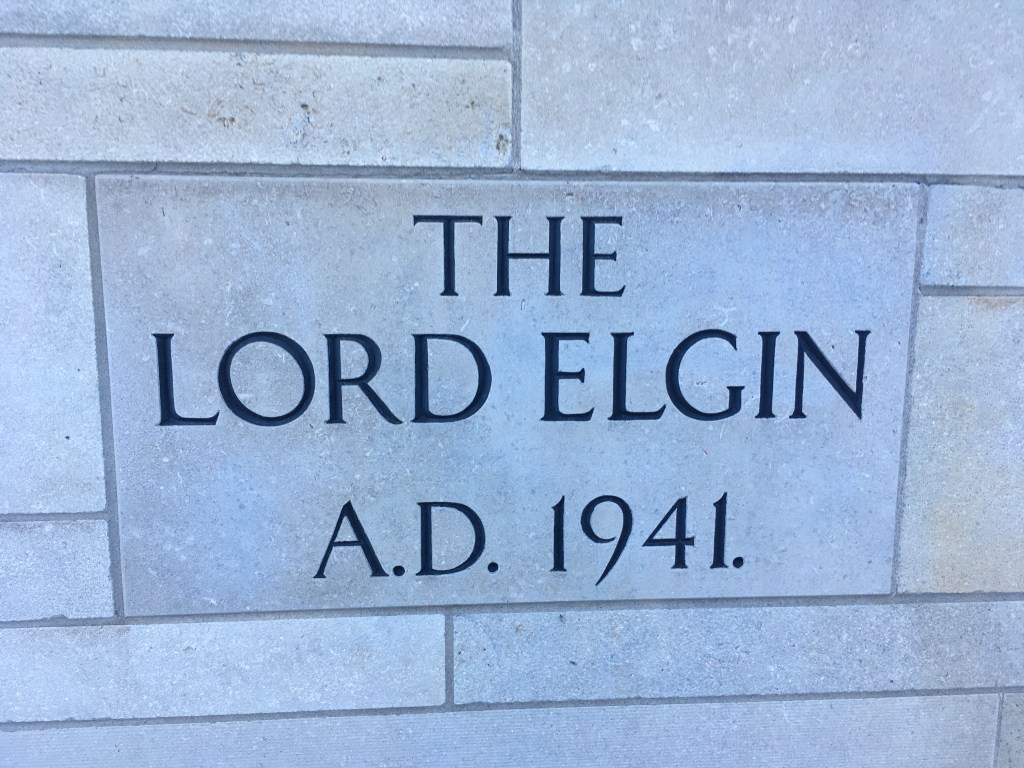
The Lord Elgin A.D 1941 – Datestone

The definition of a datestone is an engraved stone set in a building. I suppose for argument’s sake a datestone and a cornerstone are the same thing when they are actually on the corner of a building. I am making the decision to call it a datestone to call attention to the fact that you won’t find it on the corner of the building when you are looking for it. The datestone is located on the front of the building at 100 Elgin Street, of the Lord Elgin Hotel.

The construction of the Lord Elgin Building was built by local and unionized men as a newly evolved City of Ottawa priority. (The Ottawa Citizen, November 1940) The City was also enthusiastically anticipating receiving taxes from the 99-year lease because business ventures remit taxes, and government properties do not. (The Ottawa Citizen, November 1940) 

The datestone was laid during World War II on February 27th, 1941 by Prime Minister of Canada, William Lyon Mackenzie (WLM) King, with the Chairman of the Industrial Publicity Committee, Mr. Hamilton, and the President and Managing Director of Ford Hotels, Inc., Mr. Udd. WLM King’s speech touched on the Greber plan and setting an example as a city. (Library and Archives Canada, Page 1 & Page 2)

The original purpose of the Lord Elgin Hotel according to the survey done by the hotel sub-committee of the Civic Industrial and Publicity Committee, was to encourage tourists to come to Canada’s Capital. This survey was taken in New York, Washington, Philadelphia, and Baltimore and the results indicated that Americans were hesitant about planning to visit Ottawa due to having uncertainty about the availability of lodging. (The Ottawa Citizen, November 1940)

General interest surrounded the construction of the building over the year as detailed in newspaper articles. There were work delays such as a four-week delay in access to steel, slowed the construction, and threatened to change the opening date from June 1st, 1941. (The Ottawa Citizen, December 1940) Apparently, there was some debate in the general populace as to whether the “g” in Elgin was to be pronounced hard or soft. So much so that direction was received from Lord Elgin of Broomhall, Dunfermline, Scotland who stated that the family pronunciation used the hard “g”. (The Ottawa Citizen, January 1941) Rumours also had to be quashed regarding the federal government having plans to take over the new hotel for office accommodation. (The Ottawa Citizen, January 1941) Sadly a worker was killed on site, Charles Nelson Corbett of 36 Bolton Street, from a fall from the unfinished second floor. (The Ottawa Citizen, February 1941) 


The Prime Minister’s diary entry for the day contained an outline of the speech he gave and some personal thoughts on the occasion, “As I dictate this line, there comes to my thought the significance of a cornerstone of the British Commonwealth of Nations being that of Responsible Government, …”, he muses as he goes on to say that he had not thought to add this to his speech earlier in the day and wishes he had. He links the newly laid cornerstone to the cornerstone of his great-grandfather’s home in Niagara being the birthplace of Responsible Government, and he believed his part in the laying of the Lord Elgin Hotel cornerstone was the “Hand of God, in the affairs of men”, drawing the line from Lord Elgin having recognized William Lyon Mackenzie’s Responsible Government work, now being recognized in the capital. (Library and Archives Canada, Page 1 & Page 2) The stone contains issues of the daily newspapers, coins, and a signed scroll by all those taking part which read “We who are living today have faith. There will always be an England. Democracy will always prevail.” (The Ottawa Citizen, February 1941)

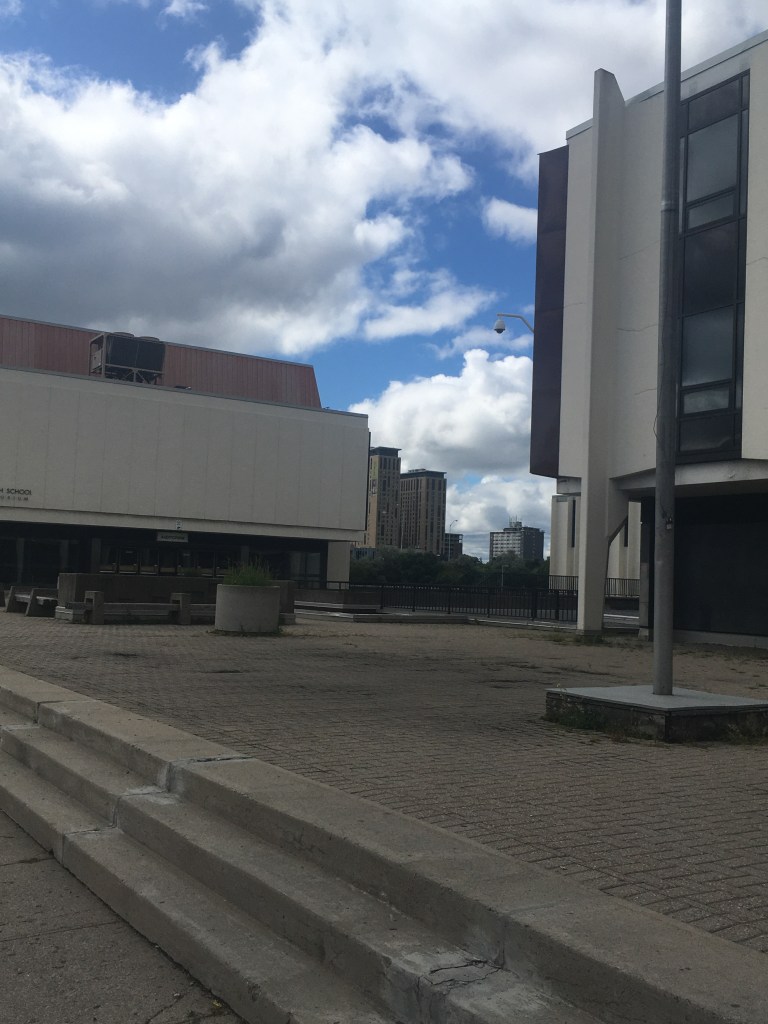
Adult High School, 300 Rochester Street

In 1965 on the corner of Rochester and Gladstone, an anticipated new school building to house The High School of Commerce (1929 – 1990) was being built as the high school had outgrown its previous locations. The High School of Commerce operated from 300 Rochester St. from 1966 until 1990 when its slowly reducing student population became too small to sustain and it became the Adult High School to fulfill a growing population niche.

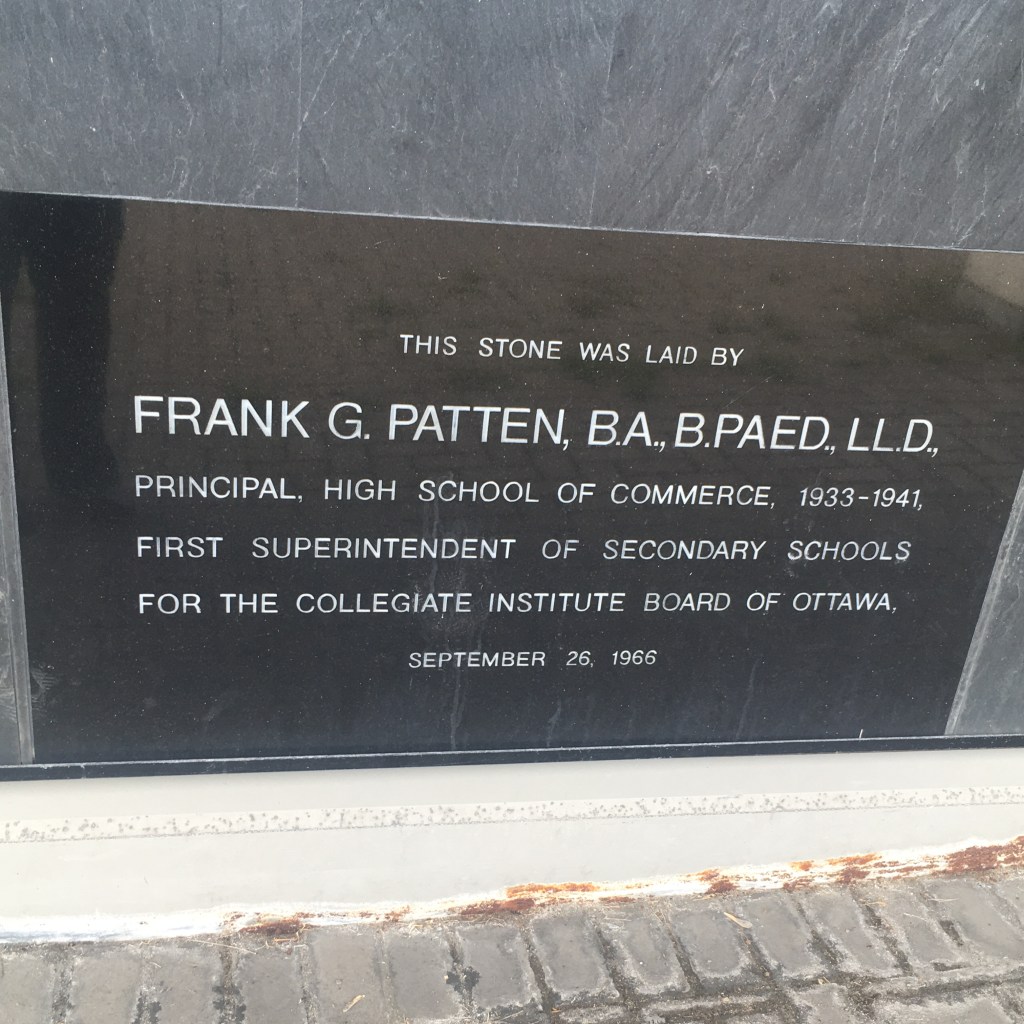
I feel that this reinvention of the space and school name is rather fitting as it echo’s the sentiments of Frank Patten who was interviewed in March 1961 before the school was to be transferred. At that time he indicated that while 60% of the Collegiate Institute Board students were taking academic courses to enter university, only 15% of each grade 9 student body would actually continue to university. In rechristening the space it takes direction from Frank’s sentiment and fulfills the needs of the students.

Looking into one moment always leads me to more rabbit holes to venture through. The professional life of Dr. Frank G. Patten voted “Citizen of the Year”, who was previously a Superintendent for Ottawa’s Collegiate Institute Board also deserves a deeper dive. There is also a book on the Collegiate Institute Board of Ottawa, but until I can safely visit the library’s Ottawa room to reference a book by Janet Keith, The Collegiate Institute Board of Ottawa; a short history, 1843 – 1969, I can only wistfully wait.

Standard Bread Company – 951 Gladstone Ave

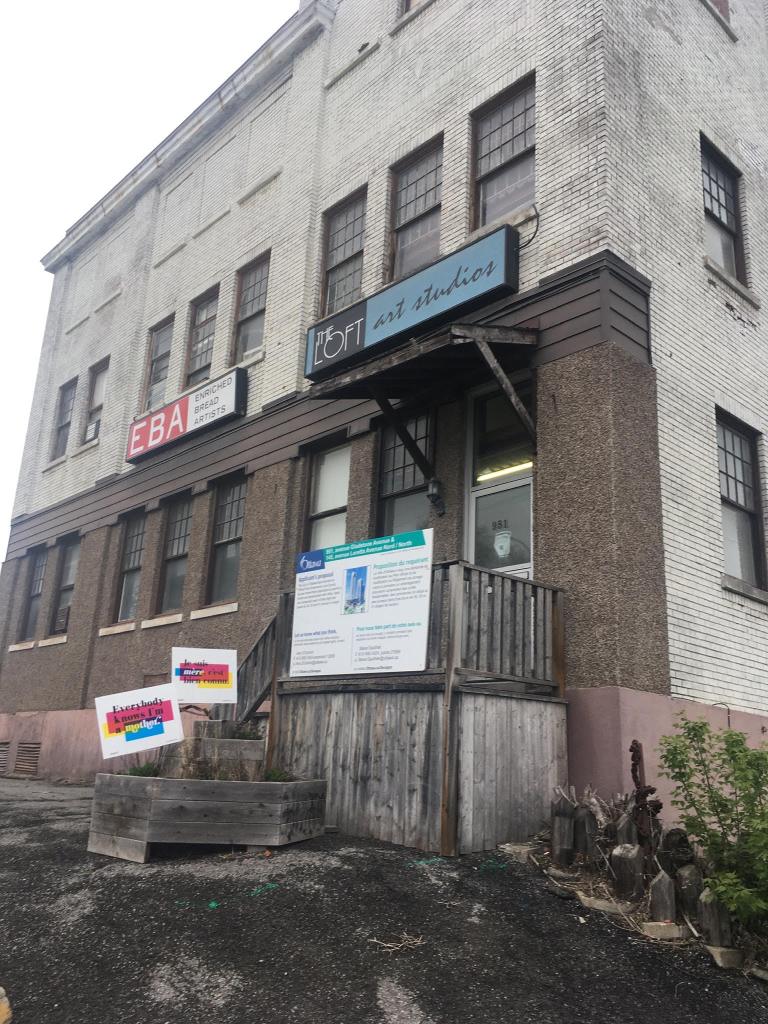
On the Northwest side of the soon-to-be constructed Gladstone LRT station is the original factory building for The Standard Bread company and current home of the Enriched Bread Artists.

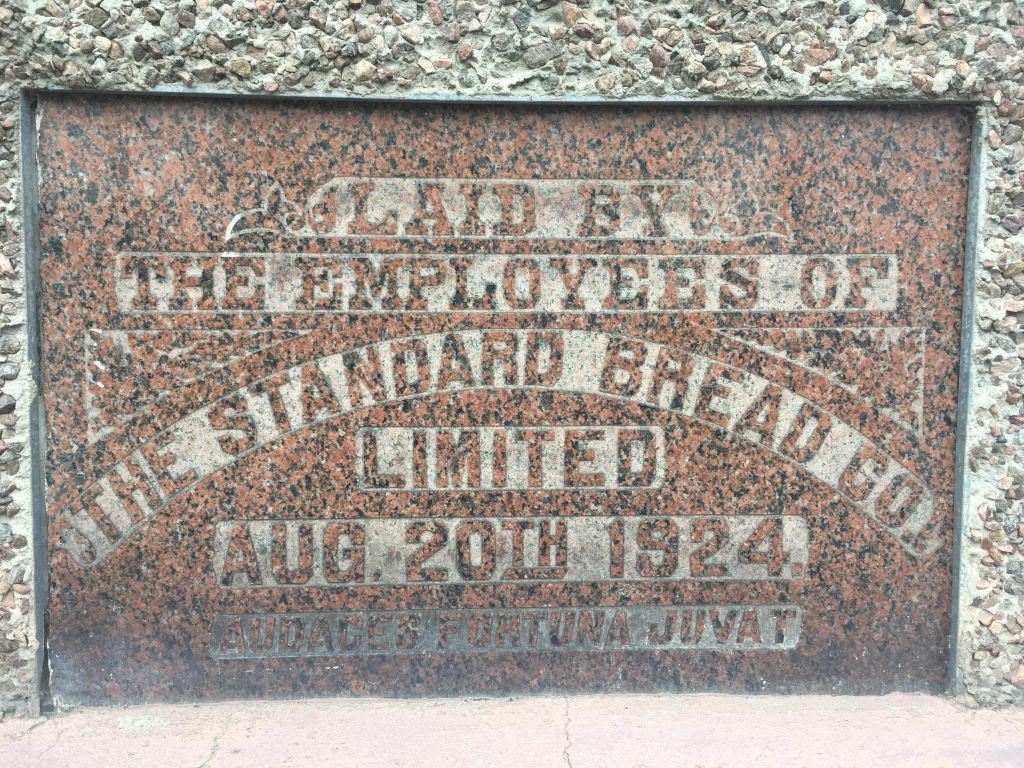
There was an early 20th century state-of-art bread making facility was built here in Ottawa. First sod was turned by Alderman E.D. Lowe on May 8, 1924 followed by the foundation stone on August 14, 1924. Mr. Max Kiefl, an 8-year employee, laid the cornerstone, which  copies of The Ottawa Journal and Citizen newspapers of May 6th [1924], the date of the turning of the sod and also copies of yesterday’s [August 20th, 1924] newspapers, a list of the names of the employees; Canadian coins; and the first issue of the Standard Bread newsletter.” According to an Ottawa Citizen article, the wording on the cornerstone, Audaces Fortuna Juvat, means, Fortune favours the bold.

The factory officially opened  on Saturday January 31, 1925 with about 3000 people attending. Even the Mayor of Ottawa, J.P. Balharrie was involved to ceremoniously turn on the power to the plant, with the Mayor of Hull, Louis Cousineau, also participating. I am well acquainted with bitter Ottawa winter and I can’t imagine the kind of spectacle that would encourage 3000 people to go to see the opening of an industrial bread factory.  


On February 7, 2020 The City of Ottawa, under the Ontario  Heritage Act gave notice of Intention to Designate 951 Gladstone Avenue for its “cultural heritage value.” I have not yet found when The Standard Bread Company officially closed its Gladstone location but according to this CBC article the building has not been in use from the late 1960’s until a group of artists, Enriched Bread Artists (EBA) rented the property for studio space and held their grand opening on October 21, 1993. Linda Hoad of the Hintonburg Community Association credits the EBA with the preservation of the site as their occupation prevented the building from being demolished due to neglect.. The Standard Bread company site is part of a new development that will rejuvenate the area in conjunction with the new Gladstone LRT station, “there’s concern that the development could ultimately force the artists to relocate”. 

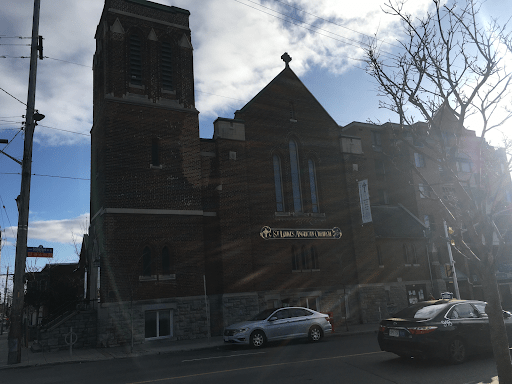
St. Luke’s Anglican Church – 760 Somerset St. West

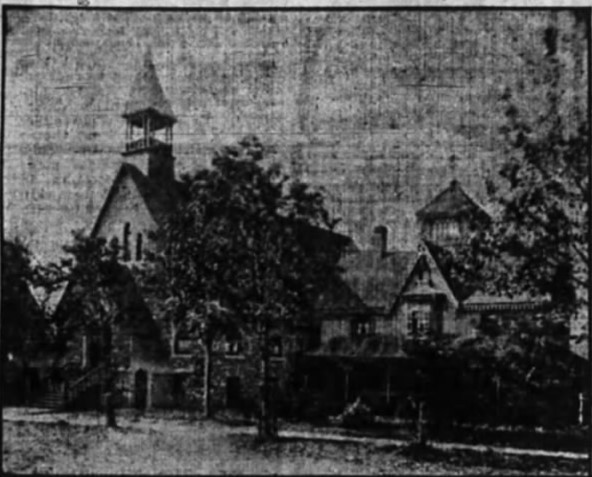
Delving into the history of this church gave me more to consider than I had anticipated. Its congregation first began as St. Paul’s, Rochesterville in 1876. I still have to pinpoint when but St. Paul’s Presbyterian church requested the church be renamed to prevent confusion and it then became St. Luke’s Episcopal Church. At this time Rochesterville was not a part of Ottawa but a suburban bedroom community. Rochesterville was annexed to the City of Ottawa January 1, 1889. 

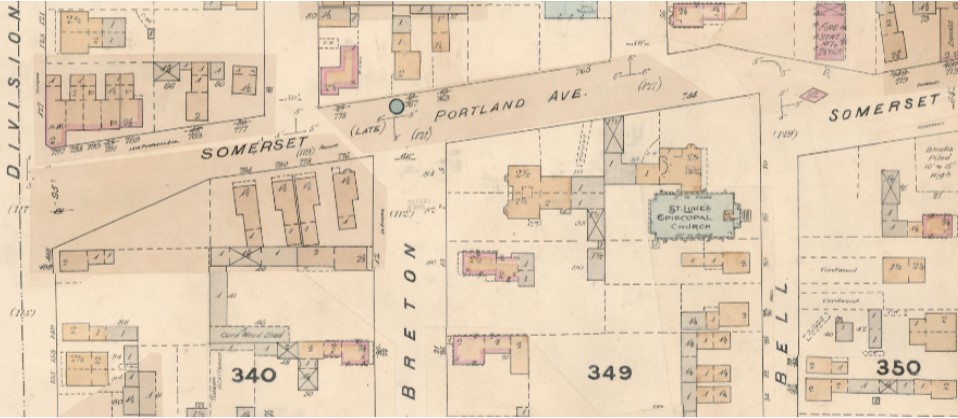
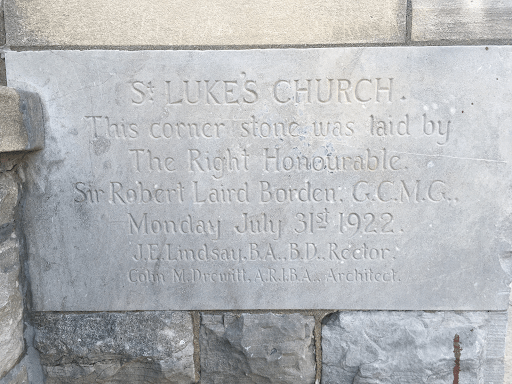
St. Luke’s Episcopal Church current location at 760 Somerset St. West  can be found on the 1902 Insurance Plan (Vol. 1, Sheet 59). It had survived the great fire of 1900, but in 1903 was destroyed by fire and rebuilt. As the congregation began to outgrow its facilities the current structure was built, and the 1922 cornerstone laid.

300 Rochester Street

In 1965 on the corner of Rochester and Gladstone, an anticipated new school building to house The High School of Commerce (1929 – 1990) was being built as the high school had outgrown its previous locations. The High School of Commerce operated from 300 Rochester St. from 1966 until 1990 when its slowly reducing student population became too small to sustain and it became the Adult High School to fulfill a growing population niche. 

I think this reinvention of the space and school name is rather fitting as it echos the sentiments of Frank Patten who was interviewed in March 1961 before the school was to be transferred, and he indicated that while 60% of the Collegiate Institute Board students were taking academic courses to enter university, only 15% of each grade 9 student body would actually continue to university. The title of the article was “High Schools Must Fill The Varied Needs of Students”. In rechristening the space it takes direction from Frank’s sentiment and fulfills the needs of the students.

Looking into one moment always leads me to more rabbit holes to venture through. The professional life of Dr. Frank G. Patten voted “Citizen of the Year”, who was previously a Superintendent for Ottawa’s Collegiate Institute Board also deserves a deeper dive. I would like to learn more about this Collegiate Institute Board of Ottawa, but until I can safely visit the Ottawa room to reference a book by Janet Keith, The Collegiate Institute Board of Ottawa; a short history, 1843 – 1969, I can only wistfully wait.

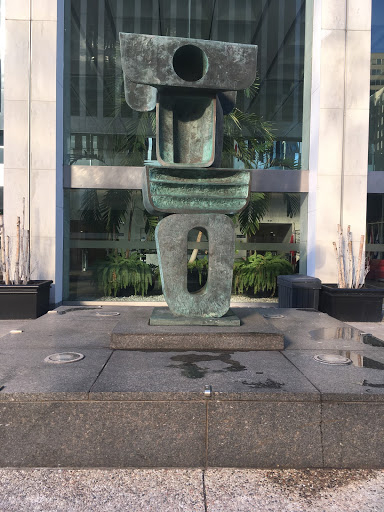
Bronze in front of 140 O’Connor Street – The L’Esplanade Laurier Building

A piece by one of the world’s most renowned sculptors of the 20th century sits quietly on the street.

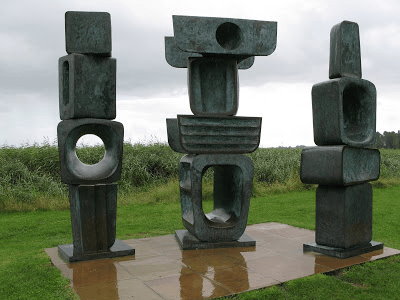
This one took a bit of digging. I couldn’t find a signature, mark or date on it. Google image search helped me discover that is a piece, which up until recently I called a statue in my head, is actually a sculpture, thanks for the clarification written by the Modern Sculpture Artists. The bronze sculpture is a part The Family of Man series by the renowned artist Barbara Hepworth created in the 1970s. Blogger Midcentry Modernist helpfully identified the sculpture and artist as well as posts a photo of the “family”

Ancestor I, was revealed to the public on Wednesday, May 19th, 1976 by Mayor Greenberg, and Hugh Poulin MP for the Ottawa Centre with curator Dr. Alan Wilkinsin of the Toronto Henry Moore Centre. The sculpture had been purchased by Olympia and York Developments for L’Esplanade Laurier and is one of the first major Barbara Hepburn pieces to be on permanent display outside in Canada. 

The reporter in the Ottawa Citizen concluded with “And after the epithets and piles of praise had been ceremoniously heaped upon it, they left it. To speak for itself.”

Ancestor I speaks, and I am glad to have finally heard it.