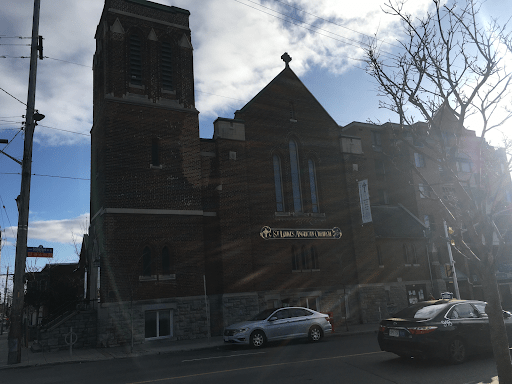
Update: April 7, 2026
This church started as a small congregation in 1872, in the village of Rochesterville, a suburb west of Ottawa, with sermons given by Rev. George Jemmet. The Reverend started his church by opening a Sunday School in his home at the corner of Preston and Elm Streets. A year later, he got the permission of the School Board to use the nearby school on Cedar Street (now renamed as part of Somerset St. West), in Rochesterville. After they outgrew the school, two more years were spent renting space in Woodlands Row, an upstairs apartment at the corner of Preston and Cedar/Somerset St. West. Their congregation continued to grow, and they built a church on the corner of Rochester and Eccles Street in 1876, dedicated to St. Paul, listed in the 1876 City Directory as St. Paul’s Church, Rochester.
The St. Paul’s episcopalian congregation increased, and in 1889, they built another church on the corner of Somerset St. West and Bell Street, on Primrose Hill. Their move to Somerset St. West happened in the same year the Village of Rochester was annexed to the City of Ottawa. The annexation resulted in two St. Paul churches of different denominations in the city of Ottawa. On November 16th, 1889, Reverend J.S. Lauder laid the cornerstone of the new church on St. Luke’s Day, and he renamed it St. Luke’s Church.
The image shows Somerset/Portland Ave further from the church than in the current 2026 road layout. (Library & Archives Canada)
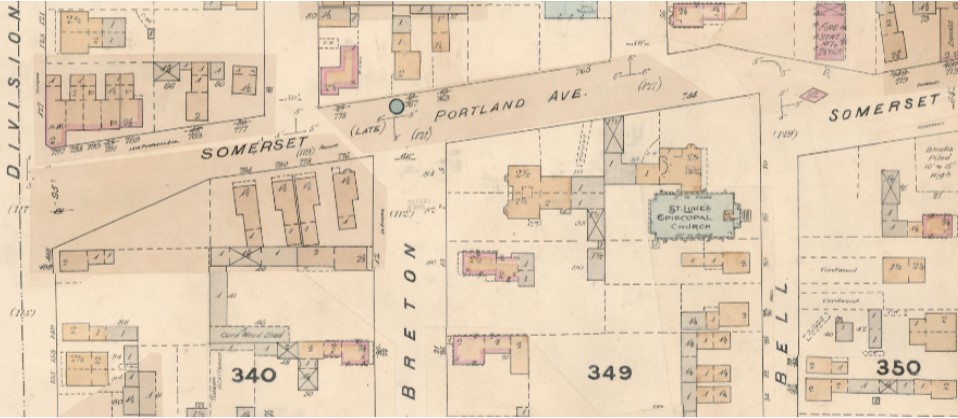
The church avoided destruction during the Ottawa/Hull fires of April 26, 1900, and May 10, 1903, but was damaged by an onsite fire on Saturday, November 7, 1903. The cause of the fire was not determined, but arson was suspected.
Photo of the church from a 1903 newspaper that had to be torn down due to extensive fire damage and rebuilt.
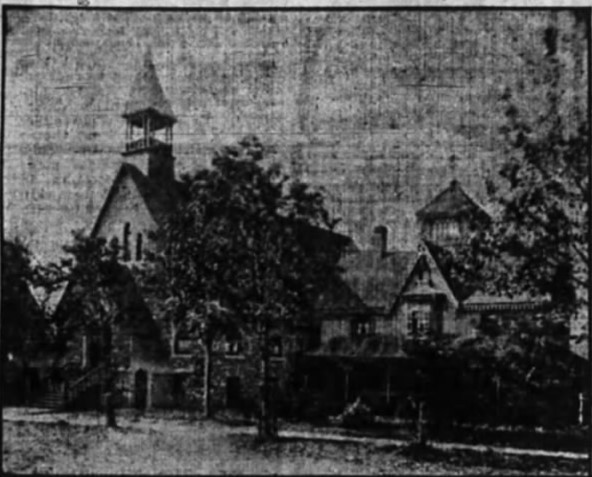
They gathered for their regular service the following Sunday, at Booth’s Hall, not far from their church, on the corner of Arthur and Somerset St. W. The nearby Erskine Presbyterian church on Bronson showed their support by offering use of their church to the congregation of the St. Luke’s Anglican church during their rebuild as they sympathised with the situation having lived through the destruction by fire and rebuild of their church. After holding a meeting, St. Luke’s decided to continue using Booth’s Hall for their services while the church was being rebuilt, but they thanked the Erskine church for their hospitality. The old church structure was fitted with a new roof, and St. Luke’s church formally opened after the disaster on February 16, 1904.
Plans had been discussed in 1903 for a new church facing Somerset Street rather than Bell Street, but due to the expensive nature of building a new church, it did not become a reality until 1922. The plans for the church were drawn up by Mr. C.M. Drewitt. The new church building was built to seat 500, and turned from Bell Street to face Somerset St. West. Demolition of the old church was expected to start on May 15, 1922. Temporary quarters for church services were in the assembly hall of Cambridge Street Public School. The building contract was awarded to Cooper & McDonald for just over $42,000 and was expected to be completed by October 15, 1922.
“It is not the church alone, which of itself is merely a collection of stones and mortar, but the spirit of the people who assemble here, and their influence on the community now and in years to come,” said Sir Robert Borden at the laying of the cornerstone on July 31st, 1922. He used a silver trowel and then presented it to the architect, Mr. Colin Drewitt. On December 22, 1922, St. Luke’s Church officially opened with an evening special service.
In 1953, the first rectory that had been attached to the church and used as Lindsay Hall was demolished to make room for another. Bishop Jefferson of Ottawa turned over the sod on September 28, 1953. Burgess and Mclean designed the new parish hall, and the contractors were George Crain & Sons for construction. The Trade and Commerce Minister, C. D. Howe, laid the cornerstone of the new parish hall on June 20, 1954.
In 1989, the Serson Clarke Parish Hall was demolished as the congregation felt that the hall would better serve the community as a non-profit social housing development, and in its place, constructed the Serson Clarke Apartments. Heritage designation and plaque were awarded to St. Luke’s Church in February 1992 at a Heritage Day awards ceremony. In 2007, a labyrinth was created in the floor of the church’s basement, and in 2013, the labyrinth was updated during renovations.
On October 12, 2022, days before the congregation had been planning to celebrate both their 100th anniversary of the historic heritage building and their 150th anniversary of the parish, a fire started and damaged the building. In December 2022, the congregation voted to disestablish itself.
This building also hosts St. Luke’s Table, a 40-year-old program that provides meals, counselling, and crisis prevention services. In the December 2022 CBC article, the Anglican diocese stated that the church building will remain with the diocese, and the program St. Luke’s Table will continue to be made available at this location. The website for St. Luke’s Table in April 2026 indicates that the program is running, but at temporary locations while they wait for renovations at 760 Somerset St. West to be completed.
References:
- Newspapers.com, articles from The Ottawa Citizen & The Ottawa Journal
- Library & Archives Canada, Insurance plan of the city of Ottawa, Canada, and adjoining suburbs and lumber districts, January 1888, revised January 1901, Sheet 59, accessed April 3, 2026.
- A History of Ottawa East – Chapter Four, Rick Wallace, [May 15, 2004], accessed January 10, 2021.
- Janeswalkottawa.ca, St. Luke’s Labyrinth, nd, accessed April 7, 2026.
- Queensu.ca, Three Parish Redevelopments (Executive Summary pdf), Kyle Gonyou, [nd], accessed April 7, 2026.
- CBC.ca
- Internet Archive, Ottawa City Directories List
- Kitchissippi Times, Home for the Holidays in 1880s Hintonburg, Dave Allston, uploaded November 30, 2020, accessed April 6, 2026.
Below: Posted January 9, 2021
Delving into the history of this church gave me more to consider than I had anticipated. Its congregation first began as St. Paul’s, Rochesterville in 1876. I still have to pinpoint when but St. Paul’s Presbyterian church requested the church be renamed to prevent confusion and it then became St. Luke’s Episcopal Church. At this time Rochesterville was not a part of Ottawa but a suburban bedroom community. Rochesterville was annexed to the City of Ottawa January 1, 1889.
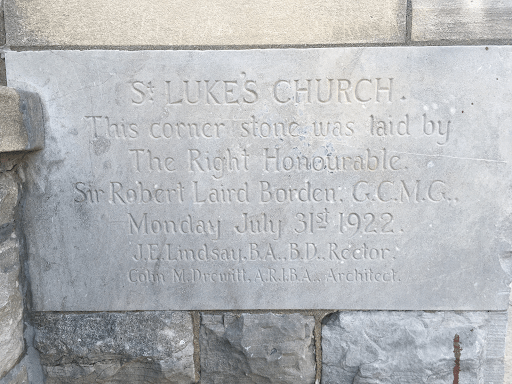
St. Luke’s Episcopal Church current location at 760 Somerset St. West can be found on the 1902 Insurance Plan (Vol. 1, Sheet 59). It had survived the great fire of 1900, but in 1903 was destroyed by fire and rebuilt. As the congregation began to outgrow its facilities the current structure was built, and the 1922 cornerstone laid.

 Plaques, Statues and Cornerstones