October 15, 2026
The Historic Landmarks Association of Canada, a precursor and Canadian historic sites advocate during the war, to the Historic Sites and Monuments Board of Canada, was created in May 1907 by the Royal Society of Canada. It published reports between 1915 and 1922 when it dissolved and became the Canadian Historical Association. The 1922 President felt that its existence had made the space to make the new government advisory board possible. The mandate of the Canadian Historical Association is to be “a bilingual not-for-profit and charitable association devoted to fostering the scholarly study and communication of history in Canada.”
After the First World War, the Commissioner of Dominion Parks, James Bernard Harkin, was able to refocus his efforts on the national heritage movement that had been paused due to the war effort. Harkin wrote a memorandum to the Minister on March 1, 1919, where he proposed “that an honorary board or committee, following the line of the Wild Life Board, be appointed, composed of men from all parts of the country who are authorities on Canadian history, to advise the Department in the matter of preserving those sites which pre-eminently possess Dominion-wide interest.” The Minister of the Interior, Hon. Mr. Arthur Meighen, who was responsible for the Dominion Parks Branch within it, agreed and through an Order-in-Council, an advisory board to the government for historic site preservation was established. The appointed founding members, considered to be authorities in their fields, were Benjamin Sulte, of Ottawa; Brigadier-General Ernest Alexander Cruikshank of Ottawa; Dr. James H. Coyne, of St. Thomas, Ontario; Mr. W.C. Milner of Halifax, Nova Scotia; and Archdeacon W.O. Raymond of St. John, New Brunswick. From the Department of the Interior, the public servants Mr. J.B. Harkin, and F.H.H. Williamson, who acted as secretary, were also attached to the board.
The first meeting of the advisory board was held in an Ottawa government office on October 28, 1919, where the members elected Brig. Gen. Cruikshank as the Chairman, and choose the boards official name Historic Sites and Monuments Board of Canada (HSMBC). In his 1921 Report of the Commissioner of Dominion Parks (for fiscal year ending March 31, 1920), Harkin wrote that a board had been formed, that these were unpaid appointments, and members had agreed to attend up to two meetings a year in Ottawa, and if the need arose members resident in Ottawa would meet to discuss issues. The new board had decided that their first order of business was to compile a list of Canadian historic sites to be considered. Additionally, historical societies, associations, and libraries were contacted to gain their cooperation, and the board had received positive responses. Future plans included the creation of a design for tablet (plaque) for use on designated sites, as well as a standard design for a cairn for those places where there is nothing available to attach the plaque. In the 1919–1920-year Dominion-wide commemoration was to be done with a budget of $5,000.
In the advisory boards second year the budget was increased to $10,000. Harkin reported in the 1922 Report of the Commissioner of Dominion Parks (for fiscal year ending March 31, 1921), that the board had met twice and had 5 local (Ottawa-based) meetings. 514 site names had been compiled, with 46 of them selected to receive the attention of the board in the way of plaques or preservation or both. Four forts were selected for the Maritime provinces of Nova Scotia and New Brunswick; ten sites, either battle sites, forts and one forge were chosen for Quebec; twenty-one sites were chosen for Ontario (which had been broken up into Niagara Front, Western Ontario, and Eastern Ontario) comprising also of forts, and battle sites, a lock, four religious sites, and an indigenous earthworks; and nine sites for all of western Canada (Manitoba, Saskatchewan, Alberta, British Columbia, the Yukon territory, and the Northwest Territories), comprising of forts and battle sites. This list of compiled sites to preserve and/or commemorate, is heavily weighted in Ontario, followed by Quebec, with a military history-based theme across Canada. Correspondence from thirty-four historical societies and associations had indicated that they were interested in supporting the preservation and commemoration of Dominion historic landmarks with HSMBC.
There is some confusion between who was the artist that designed the plaque for HSMBC. Between the 1922 Annual Report, where Harkin wrote that the Canadian artist, Major Lionel Fosbery, RCA, had designed the commemorative plaque, differs from his 1923 Annual Report, where he attributed the design to the other brother, Major Ernest Fosbery, RCA. Both brothers were artists working in Ottawa at that time, and from newspaper accounts often assisted each other in commemorative plaque works. Ernest was a painter, and most known for detailed etchings. Lionel was a sculptor, with busts of Sir Robert Borden and Sir Wilfrid Laurier in the House of Commons. C.J. Taylor, Negotiating the Past: The Making of Canada’s National Historic Parks and Sites, writes that it was Major Ernest Fosbery who was commissioned in January 1920 after a meeting with the executive committee Cruikshank, Sulte, Harkin, and Williamson, and due to the nature of the Fosbery brothers having similar work in Ottawa may account for the disparity in the Annual Reports between the two years.
These commemorative plaques were to be cast in bronze and attached to the cairns that were designed in house by the Dominion Parks Branch engineers. The cairns were fairly inexpensive to make as they were to be made out of rough field stones. Cost was a factor, as proving the economic value of commemoration and preservation of historical sites is difficult. A summary of the situation outlined by C.J. Taylor in his book, commemoration with plaques, and sometimes cairns, is cheaper, than the boards second mandate of preservation. And as Taylor also pointed out, there was a wide difference in what each province wanted between commemoration and or preservation. The Maritime’s wanted their forts preserved, which would require stabilization or restoration, and additional visitor services. Quebec and Ontario mostly wanted plaques installed, and between the costs, and the Ottawa representation on the board, Ottawa and Quebec interests were more supported as shown by the 1922 Report.
Policy to support HSMBC with budgetary support and formal authority arrived just over 30 years after its creation in 1953 as the Historic Sites and Monuments Board Act. It has been amended several times to increase its heritage jurisdiction to include recommending national designation for buildings, the designation of heritage railway stations, Canadian Prime Minister grave site commemoration, and recently in 2009 it was amended to include heritage lighthouses.
The thematic view of the HSMBC has also widened from its post-war, military history commemoration of the 1920s. Its current focus is on places, persons, and events that had an effect on Canada as whole in respect to its political, economic, and social history with prioritization under reported designations of indigenous history, environmental history, and others. Preventing uneven representation, HSMBC now has a member appointed from each province and territory, with four Ex-officio Members making it a seventeen-member board.
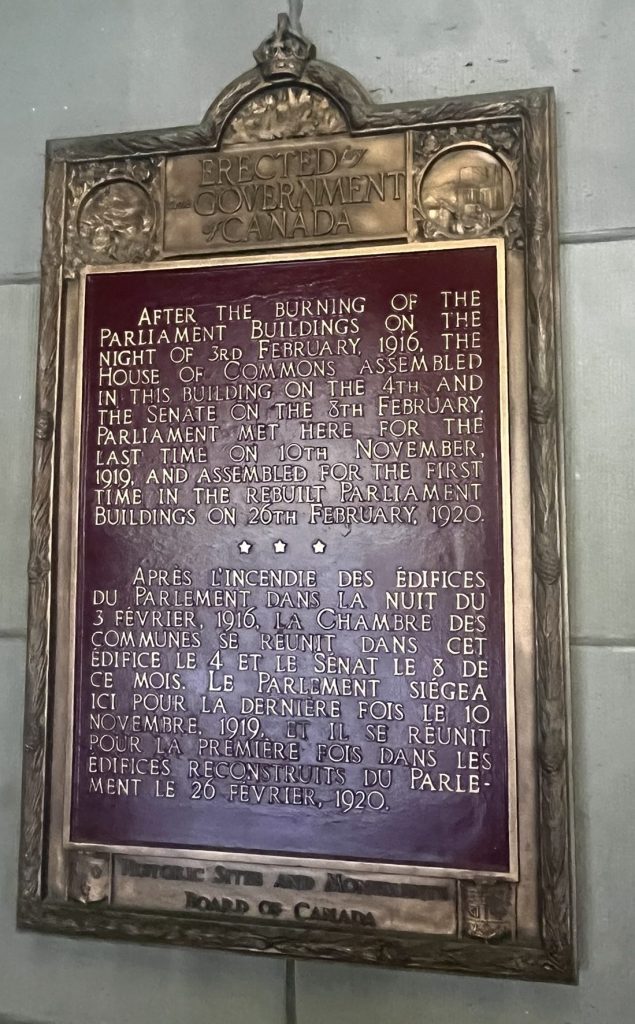
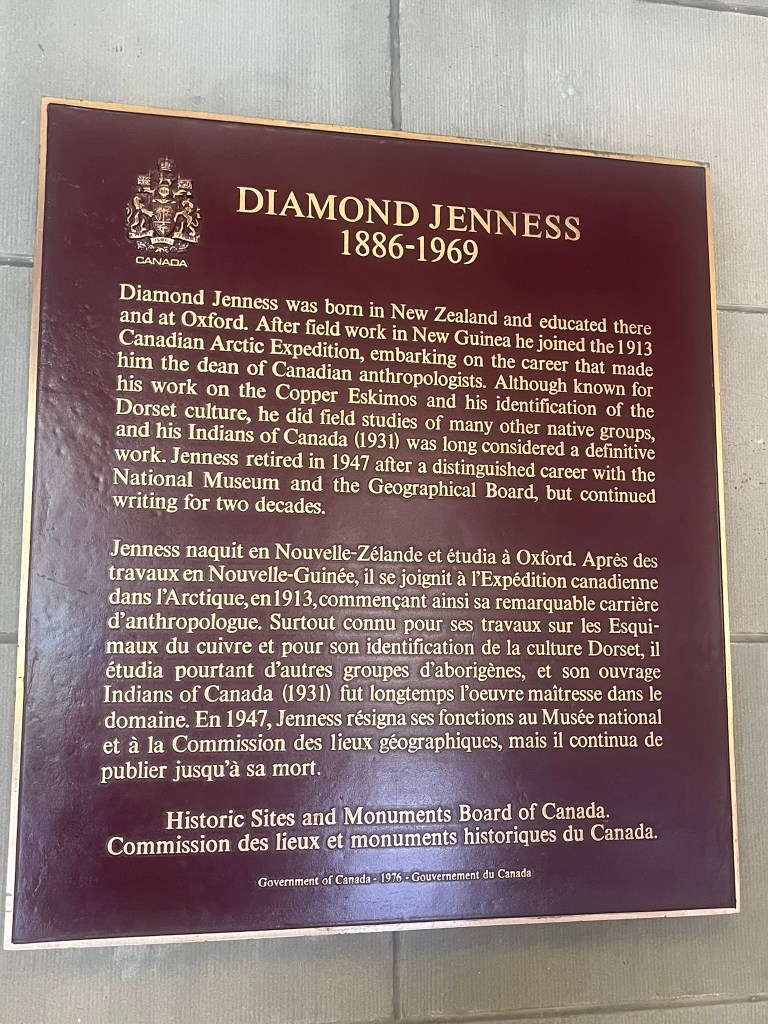
Both hung in the same foyer at the Museum of Nature in Ottawa, (Above) an original style of plaque, and (Below) a more modern style of the Historic Sites and Monuments Board Plaques. [and if anyone is listening who creates plaques, please for the love of Bert and Ernie, date when the plaque was installed]
Sources
- Canadian Historical Association, Historic Sites and Monuments Board, [President] M.H. Long, 1954
- Canadian Historical Association, About Us, [n.d.], accessed October 15, 2026
- Negotiating the Past: The Making of Canada’s National Historic Parks and Sites, C.J. Taylor, McGill-Queen’s University Press, 1990
- The Place of History: commemorating Canada’s Past: Proceedings on the National Symposium held on the occasion of the 75th Anniversary of the Historic Sites and Monuments Board of Canada, Ottawa: Royal Society of Canada, 1997 [symposium held November 26-28,1994]
- Government of Canada, Sessional Papers of the Dominion of Canada, Department of the Interior, Annual Reports:1921 -1923
- 21 Ourcommons.ca, O-568- painting (portrait) – The Right Honourable Sir John Alexander Macdonald, [n.d.], accessed October 14, 2026
- The Ottawa Citizen, Noted Canadian Sculptor Lionel G. Fosbery Dead at 77, February 11, 1956
- Government of Canada, Parks Canada, The Historic Sites and Monuments Board of Canada, date modified 2026-09-24, accessed October 10, 2026


